
What's actually under the word burnout?
- Kirstan Lloyd

- May 1
- 9 min read

The pandemic shook the tree. We tell ourselves things were okay before, idealistically, but six years on most people sitting in front of me are tired in a way that no holiday has touched. Work changed. Remote, hybrid, the office that became the kitchen table, the boundary that stopped being a boundary. The deeper issues people had always carried seemed to come forward and demanded to be acknowledged. And things just stayed frenetic. We did not slow down after the disruption. In fact, many feel we just sped up.
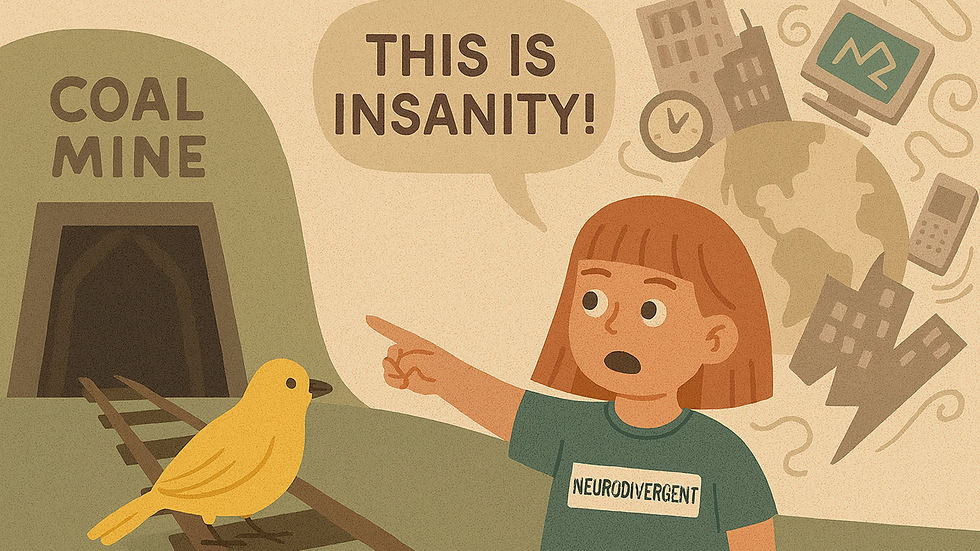
Burnout seems to have become the catchall phrase for this culturally. It is everywhere. Magazines, podcasts, LinkedIn posts, the conversation people have with their GPs. It has almost become a dominant frame for a particular kind of depletion, and it has done so quickly that it is now used loosely, as a container into which any sufficiently overwhelmed adult can place their suffering.
I find myself sceptical of the word.
Not because the suffering is not real. The suffering is very real. But the word does something specific in the consulting room. This post is an attempt to think through what we are actually talking about when we talk about burnout, and what is actually happening for the person who is using the word about themselves.
In this piece:
Why burnout, as a clinical term, is doing the wrong work for many of the people using it about themselves
What the formla definition is, and where the cultural conversation has departed from it
Why what walks through the consulting room wearing the burnout label is rarely a mismatch between person and workplace, and what it usually is instead
What two developmental routes produce later in life; one of real talent over-praised, one of compensation for what was missing
Why the work of changing this is not better coping, and what the alternative actually looks like
What we are actually treating
When a patient walks into my consulting room and tells me they are burnt out, my position is one of curiosity. Curiosity, and a particular kind of suspicion. Not toward the patient, who is doing their best to describe a real experience using the language available. But toward the label itself.
The same suspicion applies to whatever label any patient brings, be it depression, anxiety, ADHD, autism, burnout. Moreover, the same suspicion applies to my own labels as a clinician. Diagnosis is not a closed question. It is a working idea, held open, until the patient and I have built a shared understanding of what is actually going on. That shared understanding informs everything: the patient's consent to treatment, what kind of therapy will help, the goals, how long the work is likely to take. Labels have very real consequences in therapy. The wrong one closes off paths the patient needed.
The distinction I work with is between symptoms and what sits underneath them. Symptoms are what is on the surface. The tiredness, the irritability, the inability to enjoy what used to be enjoyable, the dread on Sunday evening. What sits underneath is the shape of a person. How they see themselves, how they see themselves in relation to other people, how they experience and process emotion, the unconscious ways that emotion drives behaviour. Some of this happens automatically, sometimes unconsciously.
When therapy treats only the symptoms, the patient can find themselves going around in circles. Better for a while, worse again, better for a while, worse again. Different relationships, different jobs, same shape underneath. These are often the patients who arrive in my room having tried other forms of therapy, sometimes more than once, and found that it helped for a time but did not really touch what was wrong.
What is actually walking through the door
The standard clinical framework for burnout describes a mismatch between the person and their work environment. A bad fit between what is asked and what is sustainable. Reduce the demands, change the environment, fix the workload and the person should recover.
This is a humane framework. And I almost never see this in my consulting room.
Partly because of the nature of my practice. I am usually not the first psychologist a patient sees. By the time they reach me, the obvious explanations have been considered and either addressed or ruled out. What I see instead is something different.
I see sensitive patients who drive themselves toward perfection and then collapse when the hard work does not produce the results they hoped for. I see patients who have dedicated themselves to an imagined trajectory (the partnership, the promotion, the recognition) and become quietly devastated when it does not arrive. I see patients who were told, often from very early, that they were intelligent, creative, special, and who are now struggling with the gap between the potential that was imagined for them and the more ordinary life they are actually living. I see patients with expectations of themselves that do not match their reality, their skill set, or their station in life.
What I see, in other words, is not a mismatch between the person and the environment. It is a mismatch inside the person between what they expected to be and what they have turned out to be. Between the self they have been organising their life around and where they find themselves.
This is a different problem. The standard burnout framework cannot reach it, because the standard framework is looking outward. The mismatch I am describing is internal. And what helps it is also internal.
Where this comes from
There are two developmental routes I see most often.
The first I think of as the calibration story. A child has real, locally exceptional talent. They are precocious, or beautiful, or athletically gifted, or musically remarkable. They are praised accordingly, sometimes excessively. The school recognises it. The family recognises it. Cognitive testing in childhood using instruments calibrated to be encouraging confirms what everyone already believes. The child is gifted. The child is special. And we imagine that the child is going to do extraordinary things.
Then life happens. The same child, tested as an adult, comes back with a more textured profile. Strengths and weaknesses are more pronounced than the childhood scan suggested. They might remain gifted in some areas, however, they be average in other domains. The global giftedness has resolved into something more mature: a profile with strengths and relative weaknesses.
It is easy to be the smartest child in a class of thirty. It is much harder to be the smartest in a cohort of thirty thousand at a top-tier university. And by the time you reach the global job market, the playing field has evened out. You are no longer the big fish in the small pond. You are a small fish in a very large one. The real world is more cruel than the developmental one. It is also more honest.
So the patient arrives with a self that was built, accurately, around exceptionality that was real at the time. However, it no longer seems to fit the territory they are in as the calibration catches up with reality.
The second route is different. Here the child's sense of being special is not built on something real that was over-praised. It is built compensatorily on absence, rather than presence. There are several variants.
The child whose parents could not consistently meet the basic needs of being seen, soothed, and delighted in for who they actually were. This child develops, internally, an idealised version of themselves that compensates for the warmth that was missing and alongside it, a fantasy of self-sufficiency that protects them from the unbearable feeling of needing what was not available.
The child of a parent who is narcissistically organised, who needs the child to be exceptional in order to feel exceptional themselves but whose own envy means the child's exceptionality is also subtly devalued, criticised, or appropriated. This child has to be great, and is also punished for being great. They cannot win.
The child who grows up as a caretaker for an unwell parent. This child develops a sense of being indispensable, of being the one who manages the parent's emotional state, who keeps things from falling apart, who is responsible for everyone else's wellbeing. The false, pseudo mature self that develops here is structurally indistinguishable from the responsible-self the child had to become. And underneath it sits the shame of never quite making the parent okay, because the parent was never going to be okay.
Whichever route, the adult arrives with the same configuration. A self organised around being exceptional, capable, indispensable, or somehow above the ordinary. But underneath, a quiet, unspoken inner knowing of not being that good. Of failings. Of fraudulence. Of being an imposter at risk of discovery. The exceptional self is known, by some part of them, to be not entirely true. Which is what makes the collapse so devastating when it comes. The patient is not surprised. They have been waiting, somewhere, to be found out.
What psychotherapy is for
This is where I want to say something about what I am actually trying to do with these patients, because it is not what most people imagine psychotherapy is for.
The task is change at a deep level. Not better coping. Not new strategies. Not more self-care. Change at the level of how the person is structured; how they see themselves, how they hold the world, how they manage being human.
Many of the patients I am describing live, internally, in a world that is almost divided. People are good or bad. Things are right or wrong. The self is either capable or worthless. There is no middle. The splitting is what protects them from collapse: as long as the bad is kept separate from the good, the good can remain available. The successful self, the loving partner, the competent professional. All of these can be held onto, as long as the failing, hating, inadequate parts can be kept somewhere else. When that separation fails, the patient feels entirely bad. The good has flooded out. This is what collapse actually is, internally. It is the loss of access to the good parts under the weight of the bad.
Maturity, in the sense I am thinking about, is the slow and painful realisation that things are not inherently good or bad. They are both. People are both. Work is both. The self is both. Most things in life (like, the relationships that mattered, the choices that worked out, the choices that did not) contain both at once. The capacity to hold both sides without splitting them apart, without collapsing into one or the other, is the developmental task of maturity. The experience is akin to being able to hold the truth that you have hurt people you love, that you have failed at things that mattered to you, that you are not what you set out to be. And to remain present, recognisably yourself, kind to yourself, while holding all of that without falling apart, disappearing into shame. Without splitting it off and pretending it isn't there.
You cannot teach this. You cannot CBT someone into it. The patient needs to feel, in the room, that they can be all of the things they are. Capable and inadequate, loving and hating, hoping and despairing and that another person can see them in their entirety and remain present. Not flinch. Not rescue. Not turn away. Slowly, over time, that capacity becomes internal. The patient can begin to do for themselves what the therapist has been doing alongside them. They can hold their own contradictions without splitting. They can love themselves without needing to be exceptional. They can be ordinary, and not be destroyed by it.
The work is also about offering, in the present, what was missing earlier. The experience of being seen accurately. The experience of being held by someone strong enough to be leaned on. The experience of being one of many, like other people, not alone in your difficulty. Not as substitute parenting, but as the conditions under which a more whole, more cohesive self can finally form.
And it is, perhaps most importantly, the work of holding the patient's deepest hopes alongside their darkest fears, at the same time, without choosing between them. Most patients have never had this. The hopes get held in encouraging contexts. Supportive friends, optimistic coaches, people who want the best for them. The fears get held in trauma work, or in dark moments with someone trusted, processed slowly and painfully. What this kind of therapy offers is someone who can hold both at once, walk the patient through the moving toward what they hope for and the metabolising of what they fear, as parts of the same process. Because they are parts of the same self.
This is what I think is missing from the cultural conversation about burnout. The conversation is one-dimensional. The work is bad, the person is depleted, rest is the answer. There is little understanding of internal life. No thinking about the gap between the performance and who they actually are. No understanding that what some people are presenting as burnout is the slow exhaustion of a way of being that they have outgrown, and that is now asking to be left behind.
If any of this resonates (the tiredness that no holiday has touched, the gap between who you set out to be and who you actually are, the quiet inner knowing that the version of you doing the achieving is not quite the real you), then the question worth holding is not how to recover. The question is what is being asked of you, that you have not yet been able to answer. What you are encountering may not be a failure of your functioning. It may be the beginning of something else.
Written by Kirstan Lloyd, Clinical Psychologist
Kirstan Lloyd is a clinical psychologist and psychotherapist. She works with expats, internationally mobile adults and people navigating identity transition. This article was written by Kirstan with the support of AI research tools and is grounded in literature from psychology, neuroscience, and trauma-informed care.

Comments